
The offers mostly include free insurance, exchange bonus, and free accessories
Most companies operate through a rural development sales consultant.

At the end of 2018-19, the Tata group had a consolidated debt of Rs 2.77 trillion. Tatas not only plan to avoid big-ticket acquisitions for now, the group's main focus will be on improving key metrics and reduce debt, say Shally Seth Mohile & Dev Chatterjee.

During the six-day-long event, automakers have planned 10 global launches, 26 India specific launches, six concept vehicles, seven facelifts and 21 vehicle unveilings.

If you are planning to buy an electric car in the near future, it would be highly advisable to wait for these upcoming electric SUVs.
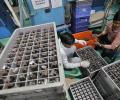
The automobile sector is considered a good indicator of economic health. It has a very long value chain, from primary materials, like metals, glass and plastic, to value-added high-end electronic components, specialised alloys, and software.

At present, there are many vehicles that weigh close to the proposed increased weight of 600 kg.

The Indian automobiles and auto components industry is likely to create additional employment for 25 million people by 2016, said experts at an auto industry conference in in Ahmedabad.
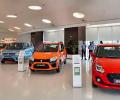
Passenger vehicle market leaders Maruti Suzuki and Hyundai on Saturday reported a decline in wholesales in December 2021, although homegrown majors Tata Motors and Mahindra & Mahindra reported growth, amid semiconductor shortage continuing to impact production. Other manufacturers Nissan and Skoda also reported an increase in December 2021 sales although Honda Cars India witnessed a decline last month. The country's largest carmaker Maruti Suzuki India (MSI) reported a 4 per cent fall in wholesales to 153,149 units in December 2021 as against 160,226 units a year ago.

Compact sedans (Maruti Dzire, Hyundai Aura, Tata Tigor)' share in the overall sedan category grew from 68% in 2021 to 74.6% in 2024. Mid-sedans' (Honda City, Maruti Ciaz, Volkswagen Virtus) share declined from 26.2% in 2021 to 20.2%.

Dealers have stocked up vehicles in the run-up to a price hike, which is expected to be announced by leading players some time this month.

Market leader Maruti Suzuki is putting finishing touches to its plan of finding its feet in what is being hailed as a battle of epic proportions in India's fastest-growing passenger vehicle segment, reports Arindam Majumder.

Maruti Suzuki India is eyeing a leadership position in the SUV segment as it continues to add new products across various sub segments, a top company official said on Wednesday. The country's largest carmaker has bolstered its presence in the high volume entry and mid level SUV segments with new Brezza and all new model -- Grand Vitara. "In every segment except SUV, we are the market leader by a distance. "It is only in the SUV that we are behind, so we need to catch up. Clearly, we have to become number one in the SUV space also," Maruti Suzuki India MD and CEO Hisashi Takeuchi said in an interaction on the sidelines of the global unveiling of Grand Vitara.

The Zica will likely reach showrooms by January 2016 and will be available for sale across the country.

Ahead of the peak festive season, India's passenger vehicle makers are staring at a cumulative order backlog of nearly 500,000 units as chip shortage continues to cripple production. The crisis is forcing companies to change their production plans frequently and take a call on the variants they can manufacture based on the availability of semiconductors. The booking numbers are not a true reflection of demand, said manufacturers.

The company is currently selling an average 2,000 units each month.

Analysts said the demand recovery in two-wheeler and car segments was skewed towards the semi-urban and rural markets.
The lockdown in Maharashtra will have a catastrophic impact on April sales, as dealers will not be able to realise the potential of festivities like Ugadi, Gudi Padwa, Baisakhi and Poila Boishakh.
An increase in sales across all categories in the automobile industry, has made need for higher working capital inevitable.
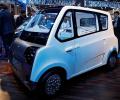
The EV industry is at an inflection point and batteries will play a critical role ahead -- batteries and related components typically constitute 35-45 per cent of an EV's costs.
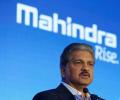
With increased consumer awareness and government support in place, it is the opportune time to enter the electric passenger vehicle segment, Mahindra Group Chairman Anand Mahindra said on Monday. With an eye on gaining leadership in the electric four-wheeler segment, the Indian auto major announced that it will launch five new electric Sports Utility Vehicles (SUVs) for both domestic and international markets, with the first four expected to hit the road between 2024 and 2026. The company would introduce the first of the five e-SUVs towards the end of 2024, starting with the Indian market.

From the customer point of view too, LFP batteries are safer and offer a longer life.

Sales of commercial vehicles were up 11.45 per cent to 56,840 units in December 2015.
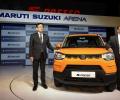
The country's largest carmaker Maruti Suzuki India will not "walk away" and fight to get back to 50 per cent market share in the domestic passenger vehicle segment, according to company Chairman R C Bhargava. The auto major, which is commemorating 40 years of operations, has seen its market share drop to 43.38 per cent in FY22 from a peak of 51.21 per cent in FY19. In order to get back its dominant leadership, the company plans to drive in models catering to both urban and smaller cities and rural areas.

German Car maker Audi plans to offer cars that can do 400 km on a single charge, says Ajay Modi.

Maruti Suzuki, Tata Motors and Hyundai stand to gain the maximum, given their large portfolio of products in the sub-4 meter segment.

Ahead of the international auto show that begins next Wednesday, the Indian auto industry continues to be buffeted with bad news. According to data released by leading automobile companies on Saturday, the industry's sales volumes in January fell about five per cent from those in the same month last year.
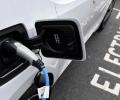
Proliferation of home chargers of around 7 KWh and above, which take six to seven hours to fully charge a car depending on the model, bring running costs down by a third or so. That, coupled with the increasing range of modern electric cars, can lead to a massive increase in sales.

The growth rate could continue for another seven years.

Due to rising input costs, Tata Motors on Saturday raised prices of its passenger and commercial vehicles by Rs 3,000-30,000 with immediate effect.
While retail sales at dealerships have suffered the full impact of demonetisation, the growth in wholesale volumes comes as dealers had relatively lower inventory after Diwali in October.

The biggest losers in the Sensex pack were Vedanta, Tata Steel, M&M, Tata Motors, Maruti, Hero MotoCorp, PowerGrid, Bharti Airtel, SBI and Coal India -- falling up to 4.48 per cent.

For players like Toyota Kirloskar and Ford, the contribution of UVs to overall sales is now well over 60%.

Cumulative sale at India's top six passenger vehicle (PV) makers dropped 0.7 per cent to 267,000 units, from 269,000 a year before.
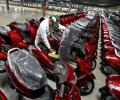
What has hit sentiment further is a draft proposal by the government to increase vehicle insurance premiums for financial year 2022-23 (FY23). Third-party motor insurance premiums have not been increased over the last two years and if this is approved, insurance costs for specific segments could rise by a fifth. The worst impacted is the 350cc and above two-wheeler segment, where premiums are up 21 per cent. Royal Enfield (Eicher Motor) is the market leader in the segment. The premiums in the 150-350cc two-wheeler category are also being inc

Maruti sold 191 units of SX4 sedan in January 2014.

New electric and hybrid vehicles on display as manufacturers plug into environment-friendly segment.

Jimny will be priced between Rs 12.7 lakh and Rs 15.05 lakh.
Among the stocks that have seen the largest cut by MFs, the DVR shares (shares with differential voting rights) of Tata Motors have seen a cut of 243 basis points (bps) in MFs' stake.

This is the first decline since June this year when car sales declined by 11%.
